Potassium permanganate / What comes out first?
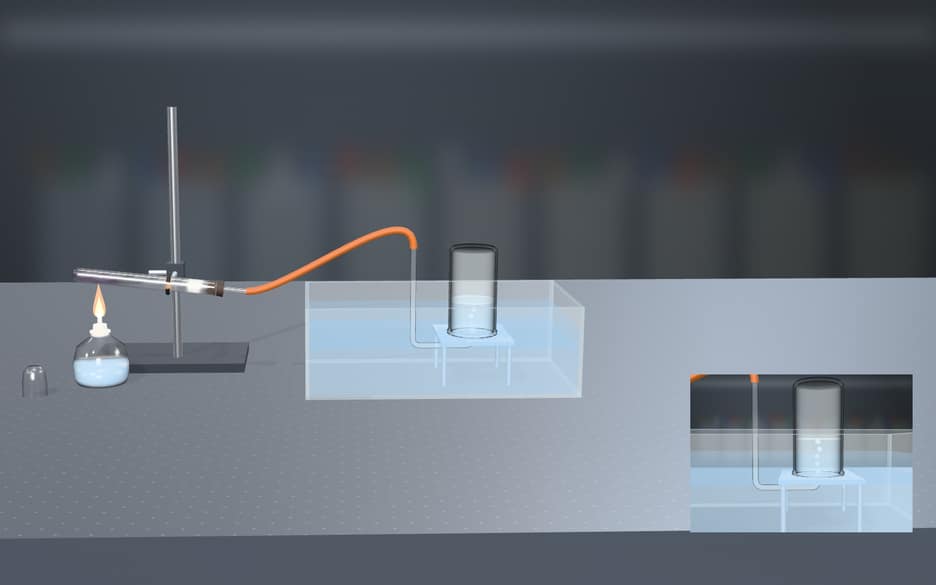
The first bubbles are not oxygen.
Once the lamp is lit, the air already inside the test tube and delivery tube warms, expands and bubbles out first. The solid has not started to decompose yet, so these bubbles are plain air, about 21% oxygen.
At about 240 °C the solid starts to decompose. The oxygen it releases mixes with the air in the tube, and the mixture bubbles out together. As oxygen builds up and air runs out, the share of oxygen in the bubbles climbs from 21%.
A steady, even stream of bubbles means the air in the apparatus has mostly been pushed out. Start collecting then, and the jar fills with fairly pure oxygen.
Potassium permanganate / Compare the two timings
Collect at the first bubbles, and the jar is only about four-fifths oxygen.
In this model, about 36.6 s after lighting the lamp the gas leaving the tube reaches 95% oxygen and the stream is steady. Collecting from then on fills the jar in 31.2 s, with about 99.1% oxygen.
If you start as soon as warming ends and the first bubbles appear (at 8 s), the expanded air and the early mixture go into the jar first. When it is full, it holds only about 82.9% oxygen.
Would that jar still relight a glowing splint? We found no reliable source for the oxygen level a splint needs, so the page draws no conclusion. The size of the splint flame only reflects the oxygen content of the jar.
Potassium permanganate / Why each step is done this way
Each rule guards against one thing.
- Tilt the mouth slightly downWater that condenses near the mouth cannot run back onto the hot bottom and crack the tube.
- Put cotton wool in the mouthIt stops potassium permanganate powder from being carried into the delivery tube.
- Warm first, then use the outer flameWarming the whole tube evenly keeps it from cracking, and the outer flame is the hottest part.
- Tube out of the water before the lamp goes outIn the other order the tube cools, the gas inside shrinks and water from the trough is sucked back into the hot tube.
- Collect over waterOxygen does not dissolve easily in water. It is slightly denser than air, so upward displacement of air also works, but collecting over water gives purer oxygen.
Hydrogen peroxide / What does manganese dioxide do?
No heating: manganese dioxide makes hydrogen peroxide break down fast.
Hydrogen peroxide solution breaks down into water and oxygen even at room temperature, but very slowly. Drip it onto manganese dioxide and it fizzes at once. In this model, 45 s of dripping gives about 386.6 mL of oxygen. Without manganese dioxide the same 45 s gives only about 0.3 mL, and what leaves the tube is mostly air pushed out by the liquid.
Weigh the manganese dioxide before and after: it is still 1.00 g, its chemical properties have not changed, and it will break down the next batch of hydrogen peroxide just as well. The tap on the dropping funnel sets the drip rate, and so it sets how fast oxygen is made.
Manganese dioxide is a catalyst: it speeds up the breakdown of hydrogen peroxide, and its own mass and chemical properties are the same before and after the reaction.
Hydrogen peroxide / Checking it is full vs testing the gas
Check fullness at the mouth; test the gas inside.
Oxygen is slightly denser than air, so it can be collected by upward delivery: the gas jar stands upright and the tube reaches almost to the bottom. Oxygen fills the jar from the bottom and pushes the air out of the mouth, so the mouth is the last place to fill with oxygen.
Checking that the jar is full asks “is it full yet?”: hold a glowing splint at the mouth without putting it in. If it relights, oxygen has reached the mouth. Testing the gas asks “is this oxygen?”: push a glowing splint into the jar. If it relights, the gas is oxygen.
In this model, halfway through collecting (at 25 s) the mouth holds about 61.0% oxygen and the jar about 71.6% on average. After 40 s of collecting, the mouth holds about 91.7% and the jar about 94.5%. The mouth is always lower than the inside, which is why you check fullness at the mouth. We found no reliable source for how much oxygen a glowing splint needs to relight, so the size of the flame in the scene only follows the oxygen content at the mouth or inside the jar.
You can also collect it over water, as in the first experiment: the jar is full when bubbles start escaping from its mouth. Collecting over water gives purer oxygen; upward delivery gives drier oxygen.
Full? Glowing splint at the mouth. Which gas? Glowing splint inside. One checks how full the jar is; the other checks what the gas is.
Carbon dioxide / Why marble and dilute hydrochloric acid?
Marble lumps with dilute hydrochloric acid give a steady, lasting stream.
In the lab, carbon dioxide is made from marble or limestone (mostly calcium carbonate) and dilute hydrochloric acid: CaCO₃ + 2HCl = CaCl₂ + H₂O + CO₂↑. In this model the gas comes off at about 11.1 mL/s once the 30 mL of acid is in; after 60 s of collecting about 477 mL of carbon dioxide has been made and the jar holds about 93.5% CO₂.
With dilute sulfuric acid, the calcium sulfate formed hardly dissolves. It coats the marble and keeps the acid away from it. In this model the gas has dropped to about 0.5 mL/s by the end of collecting, only about 109 mL is made, and the jar holds about 20.7% CO₂ (about 7.7% at the mouth).
With sodium carbonate powder, the reaction is violent the moment the acid touches it, peaking at about 124 mL/s. By the time the tube goes into the jar at 10 s, about 95% of the carbon dioxide has already escaped, and at the end only about 4.0% of the gas at the mouth is CO₂.
Moderate, controllable and easy to collect: lumps of marble or limestone with dilute hydrochloric acid. Not dilute sulfuric acid, and not sodium carbonate powder.
Carbon dioxide / Why the funnel stem must be sealed
The bottom of the thistle funnel must be under the liquid.
A thistle funnel has no tap, so it cannot control how fast the acid goes in. Its stem must reach below the liquid in the flask. This is a liquid seal: without it the gas escapes up the funnel.
The seal also works like a pressure gauge. The faster the gas flows through the tube, the higher the pressure in the flask and the higher the liquid is pushed up the stem. Estimating laminar flow in the tube, this page gets at most about 2 mm for the hydrochloric acid option and about 15 mm for the sodium carbonate powder.
Carbon dioxide dissolves in water and is denser than air, so it is collected by upward displacement of air rather than over water.
Carbon dioxide / Full, and what gas?
A burning splint at the mouth shows the jar is full; limewater shows the gas is carbon dioxide.
Is it full? Hold a burning splint at the mouth of the jar. If it goes out, the mouth is full of carbon dioxide. This page assumes a flame goes out once the gas around it is 25% CO₂; that is a teaching assumption, as no reliable source was found. After 60 s the hydrochloric acid option has about 91.0% at the mouth and the splint goes out; the sulfuric acid option has only about 7.7% and the splint keeps burning.
A splint going out only shows that the gas does not support burning; nitrogen would do the same. To show the gas is carbon dioxide, bubble it through clear limewater: CO₂ + Ca(OH)₂ = CaCO₃↓ + H₂O, and the limewater turns milky. About 5.6 mL of carbon dioxide turns all of 10 mL of saturated limewater milky; bubble on and the calcium carbonate becomes soluble calcium hydrogencarbonate, so the limewater clears again.
Full: a burning splint at the mouth. Which gas: bubble it through limewater. The first asks whether the jar is full, the second what the gas is.
Charcoal / Why lower it slowly?
Plunge it in, and the hot gas pushes the oxygen out.
The moment the glowing charcoal enters the oxygen it burns fiercely and gives off a lot of heat. The jar is open at the top, so as the gas warms and expands, the extra gas can only spill out of the mouth, and the gas at the very top leaves first.
Lowered slowly, the charcoal burns the top layer of oxygen first and then works its way down, so most of the gas pushed out is hot, used gas full of carbon dioxide. Plunged straight to the bottom, it releases its heat down there; the hot gas churns upwards and drives the unused oxygen above it out of the jar.
In this model, lowering the charcoal slowly (15 s to reach the bottom) lets about 166 mL of oxygen react with it, and about 44 mL of oxygen is pushed out. Plunging it in lets only about 147 mL react, and about 63 mL is pushed out.
Lowered slowly from the top, the charcoal meets each layer of oxygen in turn, so it burns more completely and for longer, and the result is easier to see.
Charcoal / What does it make?
Cloudy limewater shows carbon dioxide was made.
Charcoal is mostly carbon. Carbon burning completely in oxygen makes carbon dioxide. Carbon dioxide reacts with the calcium hydroxide in limewater to form calcium carbonate, which does not dissolve in water, so the limewater turns cloudy.
Calcium hydroxide dissolves only slightly in water: 10 mL of saturated limewater holds only about 0.233 mmol of it, so about 5.6 mL of carbon dioxide is enough to use it all up. Both ways of putting the charcoal in make more than 140 mL of carbon dioxide, so the limewater turns cloudy either way.
Limewater proves carbon dioxide was made, but it cannot tell the two ways apart. To compare them, look at how much oxygen reacted with the charcoal.
Iron wire / Why wait for the match?
A blazing match steals the oxygen the iron needs.
The match is only there to light the wire. Its stick is wood, which we can treat as cellulose, and burning wood uses oxygen too. Put the match in while it is still blazing and it keeps burning inside the jar, turning oxygen into carbon dioxide.
In this model the jar holds 225 mL of gas. If the match is nearly out, what is left of it uses only about 7.1 mL of oxygen, and the gas is still about 95.3% oxygen when the wire has burnt. If the match is still blazing, it uses about 53.4 mL inside the jar, more than twice the 25.0 mL the iron itself needs, and the oxygen falls to about 72.2%.
We found no reliable source for how much oxygen iron wire needs to keep burning, so this page draws no conclusion. The number of sparks and the brightness of the burning tip only sketch the oxygen level in the jar.
Wait until the match is nearly out: by then it has lit the wire, and it no longer uses up the oxygen in the jar.
Iron wire / Why water or sand in the jar?
The falling drops are hotter than 1,500 °C.
In oxygen the iron wire burns fiercely, sparks fly and a lot of heat is given out. A black solid forms, iron(II,III) oxide: 3Fe + 2O₂ → Fe₃O₄ (when lit). In air the wire only glows red; it does not burn like this.
At the burning tip the iron and its oxide melt and fall as small drops. Iron melts at 1538 °C and iron(II,III) oxide at about 1597 °C, so a molten drop is at least that hot. In this model about 87.1 mg of wire burns, forming about 120.4 mg of the oxide and giving out about 583 J of heat.
If a drop that hot lands straight on the glass, that spot heats suddenly and the jar can crack. A little water or a layer of fine sand at the bottom catches the drops first. This page always draws the water as a safety step and does not show the jar cracking.
Coil the wire so the burning keeps going, lower it slowly from the top, and keep it off the glass.
Properties of CO₂ / Pouring it into the beaker
The candles go out one by one, from the bottom up.
Pour a jar of carbon dioxide slowly down the side of the beaker and the three candles on the steps go out one by one, starting with the lowest. Carbon dioxide is denser than air, so it sinks to the bottom and builds up layer by layer; it does not burn and does not let things burn.
This page splits the gas in the beaker into 12 layers. Carbon dioxide enters at the bottom and the air it displaces spills over the rim; a flame goes out once the gas around it is 25% CO₂ (a teaching assumption). Poured slowly, the candles go out at 0.9, 1.8 and 2.7 s; poured all at once, the stream drags in air and stirs the whole beaker, and they go out at 0.2, 0.3 and 0.5 s, too close together to see an order.
The experiment shows two things at once: carbon dioxide is denser than air, and it neither burns nor supports burning. That is why it can put out fires.
Properties of CO₂ / Why the bottle caves in
Carbon dioxide dissolves, so there is less gas in the bottle.
Pour water into a soft plastic bottle full of carbon dioxide until it is about a third full, cap it at once and shake: the bottle caves in. Carbon dioxide dissolves in the water, there is less gas inside, the pressure falls below that of the air outside, and the air crushes the bottle.
This page uses Henry’s law: at 20 °C one volume of water dissolves about 0.92 volumes of carbon dioxide. After 20 s of shaking about 138 mL of carbon dioxide has dissolved in the 180 mL of water, the pressure inside is about 6.2 kPa below the outside, and the bottle has shrunk by about 23%. How far it caves in also depends on how soft the wall is; this page assumes 20 mL for every 1 kPa of difference.
Carbon dioxide dissolves in water.
Properties of CO₂ / Why litmus turns red, then purple
Carbon dioxide and water make carbonic acid, which heat breaks down again.
Bubble carbon dioxide into purple litmus and it turns red: CO₂ + H₂O = H₂CO₃, and the carbonic acid turns the litmus red. Heat the test tube and it turns purple again: H₂CO₃ =△= H₂O + CO₂↑; carbonic acid is unstable, breaks down when heated, and the carbon dioxide escapes.
This page estimates pH from the first ionisation of carbonic acid. After 15 s of bubbling the pH is about 4.3 and the solution is red; after 40 s of heating it is back to about 6.0 and purple. Litmus colour is drawn from pH: red below 4.5, purple from 5.8 to 7.5.
It is the carbonic acid, not the carbon dioxide, that turns litmus red. A dry paper flower dyed with litmus stays purple in carbon dioxide.
Carbon dioxide reacts with water to form carbonic acid; carbonic acid is unstable and breaks down easily when heated.
Think it through
Can you explain these?
When checking for leaks, why does water rise into the tube after you let go?
Your hand warms the air inside, and some of it bubbles out. When you let go, the remaining air cools and shrinks, the pressure inside drops below the outside, and water is pushed up the tube. This model gives a column of about 48 mm. If the apparatus leaked, no column would form.
Why cover the full jar under water and then stand it upright?
Covering it under water keeps air out. Oxygen is slightly denser than air, so it does not escape easily from an upright jar.
What happens if you put out the lamp first?
The tube cools, the gas inside shrinks and water from the trough is sucked back along the delivery tube into the hot test tube, which can crack. The page does not show this; the step hint explains it.
Why is carbon dioxide not usually collected over water?
Carbon dioxide dissolves in water and reacts with it, so some would be lost. It is denser than air, so upward displacement of air works.
If a burning splint goes out at the mouth, does that prove the gas is carbon dioxide?
No. Any gas that does not support burning, such as nitrogen, puts it out. Limewater is the test for carbon dioxide.
Why can carbon dioxide put out fires?
It neither burns nor supports burning, and being denser than air it settles over the burning material and keeps the air away.
Model and sources
Model and sources
The potassium permanganate experiment treats the gas in the test tube and delivery tube as well mixed: at every moment the gas that bubbles out has the average composition of the gas inside. The pressure stays at about one atmosphere, and all gas amounts are given as volumes at 20 °C and 1 atm.
- 2KMnO₄ =△= K₂MnO₄ + MnO₂ + O₂↑
- Gas temperature in the tube T(t) = T₀ + (T_h − T₀)(1 − e^(−t/τ))
- Gas flow from the tube F = g − dn/dt (g: rate of oxygen production, n: gas in the tube)
- Oxygen share of the outflow y = n_O₂ / n, with dn_O₂/dt = g − F·y
- Collection starts when warming has ended and y reaches the chosen level (95% or 21%)
The molar mass of potassium permanganate (158.03 g/mol) and its crystal density (2.7 g/cm³) come from PubChem, as does the decomposition at about 240 °C (from HSDB). The gas constant and standard atmosphere come from NIST. The 6 g of solid, 36 mL of gas space, 125 mL jar, 4 mL/s oxygen rate, 147 °C mean gas temperature and the 20 s delay before decomposition are teaching assumptions.
Not modelled: how the decomposition rate changes with temperature, layers of temperature and composition in the tube, oxygen dissolving in water, water vapour, and the results of mistakes. Readings come from the model, not from sensors. The light blue of the water is added so you can see it.
- PubChem CID 516875 · Potassium permanganate(molecular weight, density, decomposition) ↗ checked 2026-11-05
- NIST CODATA · Molar gas constant ↗ checked 2026-11-05
- NIST CODATA · Standard atmosphere ↗ checked 2026-11-05
- Wikipedia · Potassium permanganate(thermal decomposition) ↗ checked 2026-11-05
- OpenStax Chemistry 2e 11.3 · Solubility ↗ checked 2026-11-05
The hydrogen peroxide experiment treats each drop from the funnel as landing in the flask at once, where the hydrogen peroxide breaks down as a first-order reaction. The gas above the liquid in the flask is fully mixed. The gas jar is split into three layers, each fully mixed; gas enters at the bottom and the excess leaves through the mouth.
- 2H₂O₂ =MnO₂= 2H₂O + O₂↑
- Undecomposed hydrogen peroxide in the flask dH/dt = a − k·H, oxygen production g = k·H (a: amount dripped in per second; k differs with and without MnO₂)
- Gas flow from the tube F = g + q (q: drip rate; the liquid dripped in pushes out the same volume of gas)
- Oxygen share of the gas leaving the flask y = n_O₂ / n, with dn_O₂/dt = g − F·y
- Layer i of the gas jar dx_i/dt = (3F / V_jar)(x_(i−1) − x_i), with x_0 = y; the mouth is the top layer
The molar masses of hydrogen peroxide (34.015 g/mol) and oxygen (31.999 g/mol) come from PubChem; oxygen is heavier than air (about 29 g/mol on average), so at the same temperature and pressure it is slightly denser. The density of the 5% solution, 1.017 g/mL, is a straight-line interpolation between the 3% and 27% densities in the Wikipedia table. The molar gas constant and the standard atmosphere come from NIST. Treating the breakdown of hydrogen peroxide as first order follows an OpenStax worked example; its rate constant, 0.116 h⁻¹, is used as a generous upper limit for the uncatalysed reaction. The 30 mL of solution, the 0.5 mL/s drip rate, 1 g of manganese dioxide, k = 0.5 s⁻¹ with the catalyst, 115 mL of gas in the flask, a 125 mL jar split into three layers, collection starting 5 s after dripping begins and lasting 40 s are all teaching assumptions.
Not modelled: the heat given out by the reaction, water vapour, oxygen dissolving in the solution, how the grain size of the manganese dioxide changes the rate, and the real air currents and diffusion in the jar. The shades of blue in the gas jar, the colour of the liquid and the number of drops are drawn only so you can see what is happening.
- PubChem CID 784 · Hydrogen peroxide(molecular weight) ↗ checked 2026-11-06
- PubChem CID 977 · Oxygen(molecular weight) ↗ checked 2026-11-06
- Wikipedia · Hydrogen peroxide(density of aqueous solutions, catalytic decomposition) ↗ checked 2026-11-06
- OpenStax Chemistry 2e 12.4 · Integrated Rate Laws(first-order decomposition of H₂O₂) ↗ checked 2026-11-06
- OpenStax Chemistry 2e 12.7 · Catalysis ↗ checked 2026-11-06
The carbon dioxide experiment uses the same three stages as the hydrogen peroxide one. Acid poured down the thistle funnel lands in the flask at once and reacts at the surface of the solid; the gas above the liquid is well mixed; the gas jar is split into three layers, each mixed on its own, with gas entering at the bottom and the excess leaving at the mouth.
- CaCO₃ + 2HCl = CaCl₂ + H₂O + CO₂↑
- CaCO₃ + H₂SO₄ = CaSO₄ + H₂O + CO₂↑
- Na₂CO₃ + 2HCl = 2NaCl + H₂O + CO₂↑
- Rate of reaction r = k·A·s·f (A: acid left in the flask; for sulfuric acid s = e^(−ξ/ξ₀), ξ being the amount reacted; for sodium carbonate powder f is the fraction of powder left)
- Gas from the tube F = g + q, with its CO₂ share y from dn_CO₂/dt = g − F·y (g: rate of gas production, q: rate of adding acid)
- Liquid pushed up the stem h = 8μL·F / (πr⁴·ρg) (laminar resistance of the tube)
- CO₂ + Ca(OH)₂ = CaCO₃↓ + H₂O; CaCO₃ + CO₂ + H₂O = Ca(HCO₃)₂
Molar masses of calcium carbonate, sodium carbonate and calcium hydroxide, and the solubility of calcium hydroxide (1.73 g/L), are from PubChem; the viscosity of carbon dioxide (about 14.7 μPa·s) is from the NIST WebBook; the gas constant and standard atmosphere are from NIST. Teaching assumptions: 2 mol/L hydrochloric acid or 1 mol/L sulfuric acid, 30 mL poured in 5 s; 10 g of marble or 3 g of sodium carbonate; the rate and coating constants; 165 mL of gas in the flask; a 125 mL jar in three layers; collecting from 10 s, for 60 s; limewater taking up 35% of the carbon dioxide bubbled in; and the 25% threshold for a flame to go out.
Not modelled: heat from the reaction, hydrogen chloride given off by the acid, the marble getting smaller, froth spilling over, the real flow and diffusion in the jar, and the higher liquid column that turbulent flow would give. The grey shading in the jar and the colour of the liquids are drawn so you can see them; readings come from the model, not from sensors.
- PubChem CID 10112 · Calcium carbonate(molecular weight) ↗ cited 2026-11-07
- PubChem CID 10340 · Sodium carbonate(molecular weight) ↗ cited 2026-11-07
- PubChem CID 6093208 · Calcium hydroxide(solubility, molecular weight) ↗ cited 2026-11-07
- NIST Chemistry WebBook · Thermophysical properties of fluid systems(CO₂ viscosity) ↗ cited 2026-11-07
- NIST CODATA · Molar gas constant ↗ cited 2026-11-07
The charcoal experiment splits the gas in the jar into 20 layers from bottom to top. The charcoal reacts only with the gas within about 1 cm of it, at a rate proportional to the oxygen share of that gas. C + O₂ → CO₂ uses one volume of oxygen and makes one volume of carbon dioxide, so the reaction itself does not change the total amount of gas.
Part of the heat from burning warms the gas around the charcoal. The jar is open, so the pressure stays at about 1 atm: gas that expands beyond the jar’s volume spills out of the mouth, top layer first, and when the gas cools and shrinks, air flows back in. Hot gas below cold gas churns over and mixes quickly; hot gas above cold gas stays layered and mixes only slowly. Burning counts as over once the oxygen around the charcoal falls below its level in air (21%).
- C + O₂ =ignite= CO₂ (one volume of O₂ for one volume of CO₂)
- Oxygen use rate r = r_max · x (x: O₂ share of the gas around the charcoal)
- Each layer’s volume v = m·T/T₀; whatever exceeds the jar’s volume spills out of the mouth
- Each mL of O₂ used gives the gas η·393.51 kJ/mol ÷ 24.06 L/mol ≈ 0.98 J (η = 6%)
- CO₂ + Ca(OH)₂ = CaCO₃↓ + H₂O
- 10 mL of saturated limewater: 1.73 g/L × 10 mL ÷ 74.09 g/mol ≈ 0.233 mmol Ca(OH)₂
The standard enthalpy of formation of carbon dioxide (−393.51 kJ/mol) is from the NIST WebBook. The solubility of calcium hydroxide at 20 °C (1730 mg/L) is from HSDB via PubChem, and the molar masses of calcium hydroxide and calcium carbonate are from PubChem. The heat capacity of the gas is taken as that of oxygen, 29.4 J/(mol·K), from NIST WebBook data. The 250 mL of pure oxygen, the 85 mm depth, the oxygen use rate of 8 mL/s in pure oxygen, the 6% of the heat that warms the gas, the 5 s cooling time, the mixing coefficients and the 10 mL of limewater are all teaching assumptions.
Not modelled: changes in the charcoal’s temperature and size, the real shape and radiation of the flame, the temperature of the glass, the cooling after the charcoal is taken out, and excess carbon dioxide turning calcium carbonate into soluble calcium hydrogencarbonate. The brightness and the blue layers are only illustrations, since oxygen is colourless; readings come from the model, not from sensors.
- NIST Chemistry WebBook · Carbon dioxide(enthalpy of formation) ↗ checked 2026-11-06
- NIST Chemistry WebBook · Oxygen(gas heat capacity) ↗ checked 2026-11-06
- PubChem CID 6093208 · Calcium hydroxide(solubility, molecular weight) ↗ checked 2026-11-06
- PubChem CID 10112 · Calcium carbonate(molecular weight) ↗ checked 2026-11-06
The iron-wire experiment treats the gas in the jar as well mixed, with no exchange through the mouth. The match stick is treated as cellulose and its water vapour condenses. The coil burns from the bottom up at a steady rate.
- 3Fe + 2O₂ → Fe₃O₄ (when lit)
- C₆H₁₀O₅ + 6O₂ → 6CO₂ + 5H₂O: about 890 mL of oxygen per gram of wood
- Oxygen share in the jar x = (V_O₂,0 − V_match − V_iron) / (V_gas − V_iron)
- Spark sketch level k = (x − 21%) / 79%: a picture, not a measured law
The molar mass of iron (55.84 g/mol), its density (7.874 g/cm³), its melting point (1538 °C) and the atomic masses of C, H and O come from the PubChem periodic table. The molar mass (231.53 g/mol) and melting point (1597 °C) of iron(II,III) oxide come from PubChem, and its standard enthalpy of formation (−1120.89 kJ/mol) from the NIST Chemistry WebBook. The 250 mL jar, 25 mL of water, 99% oxygen, 0.3 mm wire, 7-turn coil, 0.08 g match stick, a match that burns out in 20 s in air and at 0.02 g per second in the jar, and a wire that burns in 6 s are all teaching assumptions.
Not modelled: how the burning speed depends on the oxygen level, unburnt iron inside the drops, carbon dioxide dissolving in the water, gas moving in or out through the mouth, and the heat making the gas expand. The wire is drawn about 1.2 mm thick so you can see it, and the water is tinted light blue for the same reason.
- PubChem · Periodic Table(Fe, C, H, O: atomic mass, melting point, density) ↗ checked 2026-11-06
- PubChem CID 16211978 · Iron oxide (Fe3O4)(molecular weight, melting point) ↗ checked 2026-11-06
- NIST Chemistry WebBook · Magnetite(enthalpy of formation) ↗ checked 2026-11-06
- NIST CODATA · Molar gas constant ↗ checked 2026-11-06
- NIST CODATA · Standard atmosphere ↗ checked 2026-11-06
The properties experiment has three separate small models. The gas in the beaker is split into 12 layers in series: poured carbon dioxide enters at the bottom and neighbouring layers also exchange gas at a set rate. In the soft bottle, dissolved carbon dioxide moves towards Henry’s-law equilibrium, the gas obeys the ideal gas law and the wall gives way according to its softness. In the litmus, carbon dioxide approaches saturation while bubbling and escapes while heating, and pH follows from the first ionisation of carbonic acid.
- CO₂ + H₂O = H₂CO₃
- H₂CO₃ =△= H₂O + CO₂↑
- Layer i of the beaker: dx_i/dt = (Q·N/V)(x_(i−1) − x_i) + k_x(x_(i+1) − 2x_i + x_(i−1)), with x_0 the CO₂ share of the poured gas
- Dissolving: dn/dt = k_s(H·p_CO₂·V_water − n), H = 3.3×10⁻⁴ mol/(m³·Pa)·e^(2400(1/T − 1/298.15))
- In the bottle p·V = n·R·T, V = V₀ − C(p₀ − p) (C: softness of the wall)
- [H⁺] = √(K_a1·c + K_w), pK_a1 = 6.35
The Henry’s-law constant of carbon dioxide and its temperature coefficient are from Sander’s compilation (2015); the pKa1 of carbonic acid (6.35) and the colour range of litmus (pH 4.5–8.3) are from Wikipedia. Teaching assumptions: a 500 mL jar holding 95% CO₂ with nine-tenths poured out; 380 mL of gas in the beaker in 12 layers; a slow pour of 6 s dragging in a fifth as much air and a fast pour of 1.5 s dragging in as much air again; a 530 mL soft bottle with 180 mL of water and a wall softness of 20 mL/kPa; the dissolving rate when shaken; the rates of uptake while bubbling and escape while heating; the 25% threshold for a flame to go out; and the mapping from pH to litmus colour.
Not modelled: the hot air rising from the candle flames and the oxygen they use, changes in water temperature, the buffering of the litmus itself, how the ionisation constants change when hot, and the solution taking up carbon dioxide from the air again as it cools. The grey shading in the beaker and jar is drawn so you can see it.
- Sander (2015) · Compilation of Henry’s law constants (version 4.0) for water as solvent, ACP 15, 4399 ↗ cited 2026-11-07
- Wikipedia · Carbonic acid(pKa) ↗ cited 2026-11-07
- Wikipedia · Litmus(pH range) ↗ cited 2026-11-07