OPOpenPithMake curiosity visibleA science reader you can explore ↗
Home / Subjects

BIOLOGY

Biology

See the inner order of life

Start with a cell. Discover how life builds boundaries, exchanges matter, and coordinates its structures.

  • 2labs
  • 15experiments
  • 3articles
Start the tour

The cell

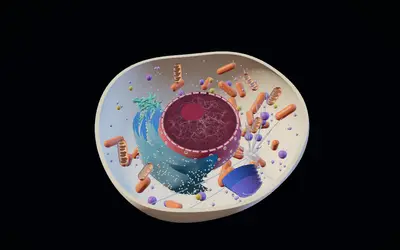
The smallest complete unit of life. Open it up to see its boundary, factories and transport lines.

1 labs10 experiments

Life at work

The classic investigations: change one condition and see how a living process responds.

1 labs5 experiments

SHORT READS

Start from everyday questions

01 / Cells and scale

How many cells are in a drop of blood?

A small drop of blood holds hundreds of millions of red blood cells. Living things are made of cells; cells are simply too small to see with the naked eye.

Start reading ↓
02 / Plant cells and chloroplasts

Why are leaves green?

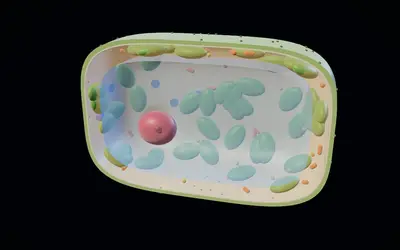
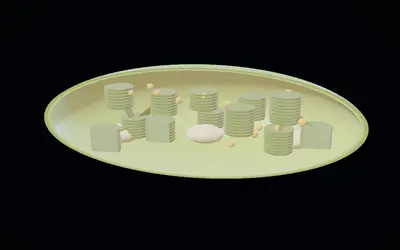
Leaf cells are full of chloroplasts. Chlorophyll absorbs red and blue-violet light and reflects green light back.

Start reading ↓
03 / Cells gaining and losing water

Why do salted greens release water and go limp?

When the solution outside a cell is more concentrated than the sap inside, the cell loses water.

Start reading ↓

How many cells are in a drop of blood?

A small drop of blood holds hundreds of millions of red blood cells. Living things are made of cells; cells are simply too small to see with the naked eye.

Compare scales in the cell atlas ↗

A human red blood cell is about 7–8 micrometres across, and a micrometre is a thousandth of a millimetre. A microlitre of blood usually holds four to five million red blood cells, and a drop is a few tens of microlitres, so one drop contains hundreds of millions of them.

Most animal and plant cells are 10–100 micrometres across, so we need a microscope to see them clearly. In 1665 Robert Hooke looked at a thin slice of cork through his own microscope, saw many small compartments and called them “cells”. What he saw were in fact the walls left behind by dead cells.

In the 19th century Schleiden, Schwann and others set out the cell theory: plants and animals are made of cells, and the cell is the basic unit of structure and function in living things. It was later extended with “new cells arise from existing cells by division”. Viruses have no cellular structure and can only reproduce inside living cells.

Think about it: A red blood cell is about 7 micrometres across. How many would you need, lined up side by side, to make a row 1 centimetre long?

1 centimetre is 10,000 micrometres, and 10,000 ÷ 7 ≈ 1,400 cells. More than a thousand cells in a row are only about as wide as a fingernail.
Back to this subject’s contents ↑

Why are leaves green?

Leaf cells are full of chloroplasts. Chlorophyll absorbs red and blue-violet light and reflects green light back.

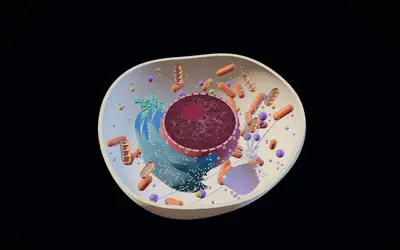
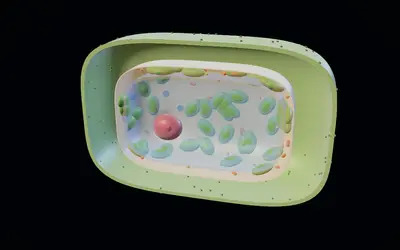
Compare an animal cell and a leaf cell ↗

Sunlight is a mixture of many colours. Chlorophyll in the chloroplasts mainly absorbs red and blue-violet light and absorbs very little green. The green light is reflected or passes through the leaf and reaches our eyes, so the leaf looks green.

The chloroplast is where photosynthesis happens. It uses light energy to build organic matter, such as starch, from carbon dioxide and water, and releases oxygen. Leaf cells contain many chloroplasts, so leaves are the main organs where plants make organic matter.

Compared with animal cells, plant cells usually also have a cell wall and a large vacuole. Only the green parts that receive light have chloroplasts; root tip cells generally have none. In autumn chlorophyll breaks down, and yellow and orange carotenoids that were hidden become visible, so many leaves turn yellow.

Think about it: Can you see chloroplasts when you look at the inner epidermis of an onion bulb scale under a microscope?

Usually not. These cells grow in the dark and have no chloroplasts. In class they are often stained with iodine solution so that the nucleus and other structures show up clearly.

Back to this subject’s contents ↑

Why do salted greens release water and go limp?

When the solution outside a cell is more concentrated than the sap inside, the cell loses water.

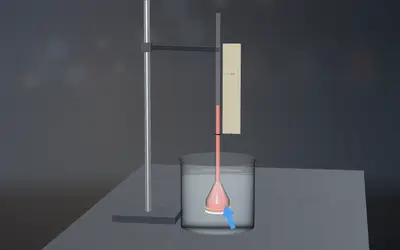
Change the concentration in the cell atlas ↗

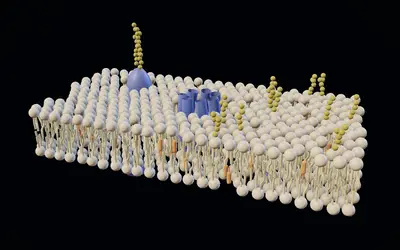
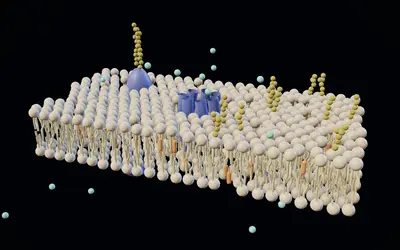
The cell membrane lets water molecules pass but blocks many dissolved substances. After salting, the solution on the leaf surface is far more concentrated than the cell sap, so water seeps out of the cells. The leaves go limp and water collects on the plate.

When a plant cell loses water, the cell wall keeps roughly its shape, but the living layer inside shrinks and pulls away from the wall. This is called plasmolysis. In reverse, soak wilted greens in fresh water: the cells take up water, the living layer presses tightly against the wall, and the leaves become crisp again.

Animal cells have no cell wall. A red blood cell placed in pure water takes up water, swells and may burst; in strong salt water it loses water and shrivels. That is why fluids given through a drip must have about the same concentration as blood plasma.

Think about it: Why do hospitals usually use 0.9% saline in drips instead of pure water?

A 0.9% sodium chloride solution has about the same concentration as blood plasma, so red blood cells neither gain nor lose much water. Pure water would make them swell and possibly burst.

Back to this subject’s contents ↑