01Dissolved salt is invisible to the eye.Sand remains solid in the water. Brine can look clear, but clear does not mean solute-free.
02Paper retains solid particles; brine passes through.Filtration removes insoluble impurities. Any excess salt that has not dissolved can also remain in the residue.
03As water evaporates, salt crystallizes.Stop heating when plenty of solid appears and let residual heat finish drying. Soluble impurities may still remain.
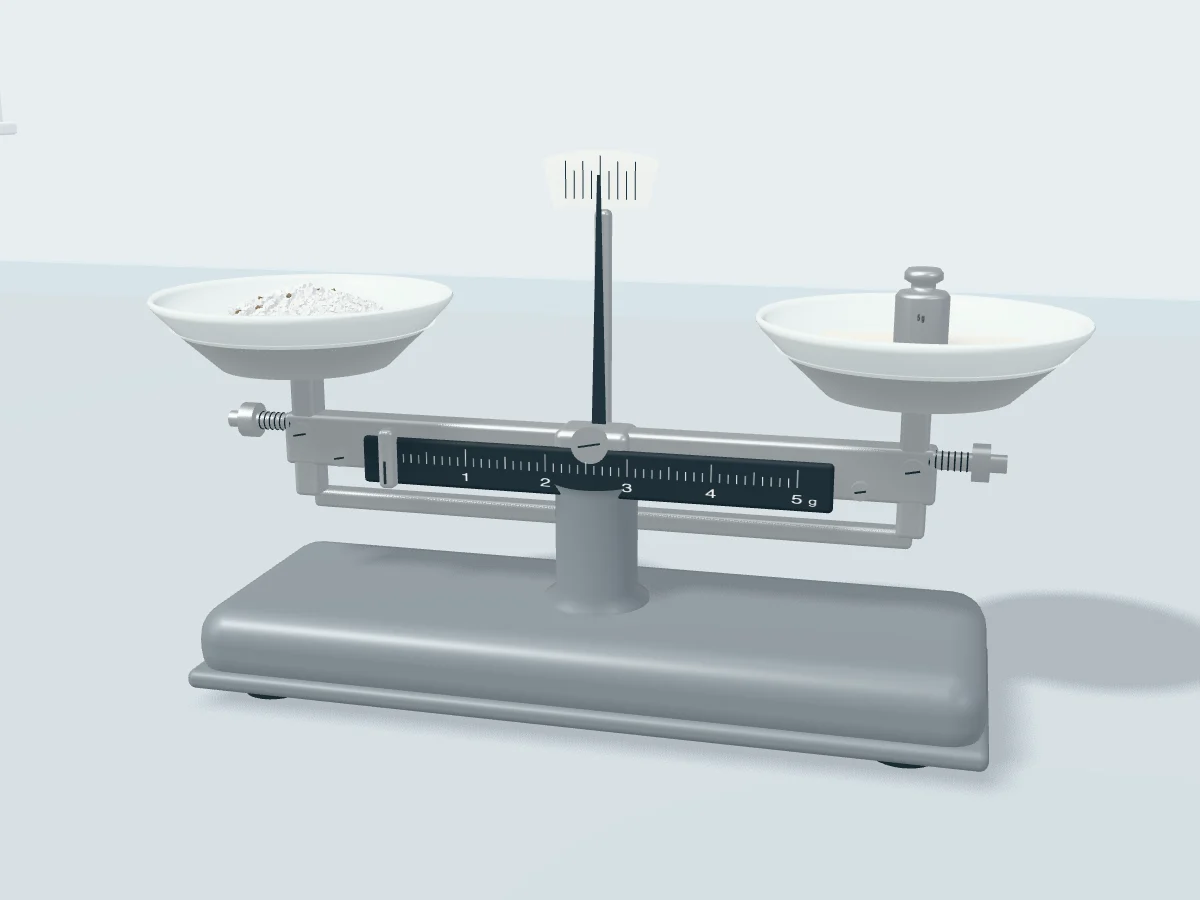
01Weigh the crude saltLevel the balance first. Line both pans with matching paper. Put crude salt on the left and weights on the right to prepare about 5 g.This 5 g is the prepared sample, not an amount that must all be added to the water.
02Measure and transfer waterStand the measuring cylinder upright on a level surface. Measure about 10 mL of water, then transfer it to the beaker.Read at eye level with the lowest point of the concave meniscus.
03Add portions and stir gentlyAdd a small portion of crude salt, then stir gently with the glass rod. Watch the white salt grains shrink while the sand remains.Avoid striking the sides or bottom of the beaker with the rod.
04Stop adding and weigh what remainsStop adding when no more salt dissolves. Keep and weigh the unused sample. Subtract it from the starting mass to find the amount added.Undissolved sand alone does not mean the brine is saturated. Check whether salt grains continue to dissolve.
05Fold and open the filter paperFold the circular paper into a semicircle, then fold again. Open one side to form a cone with one layer on one side and three on the other.Identify the thicker, triple-layer side. The glass rod will rest gently against it.
06Wet the paper and fit it to the wallPlace the paper in the funnel and wet it with a little water. Fit it against the inner wall and release trapped air bubbles.A good fit helps filtration. Air bubbles mainly slow the flow; they do not necessarily make the filtrate cloudy.
07Set up and check the two levelsSupport the funnel securely in the iron ring. Keep the paper edge below the funnel rim and the liquid below the paper edge.Position the receiving beaker so the funnel stem touches its inner wall.
08Filter along the rod with three contactsKeep the spout against the rod, the rod against the triple paper layer, and the funnel stem against the receiving beaker’s inner wall. Pour slowly, retaining sand on the paper.The filtrate should be clear. If it is cloudy, check for torn paper, an overflowing liquid level or a dirty receiving beaker.
09Transfer the filtrate to the dishSlowly pour the clear filtrate into the evaporating dish. Keep the liquid below two-thirds of the dish’s capacity.Two-thirds refers to volume, not two-thirds of the dish’s height.
10Heat and stir continuouslySecure the dish in the iron ring. Heat it with the spirit lamp while stirring continuously. Water decreases and salt begins to crystallize.Stirring distributes heat and reduces splashing. Water vapour is invisible; watch the falling liquid level and crystals.
11Extinguish and use residual heatWhen plenty of solid appears but the dish is still damp, cover the lamp with its cap. Leave the dish in place and let residual heat finish drying.Do not keep heating until completely dry, and never blow out a spirit lamp.
12Cool, transfer and weighLet the dish cool and lift it with crucible tongs. Use the glass rod to transfer the salt onto weighing paper, then weigh the recovered solid.Record the measured mass. The salt is only partly purified; soluble impurities may remain. Recovery yield is not the same as purity.
 Preparing the laboratory…