01 / Why does it keep going?
The stop catches the cart, not the block.
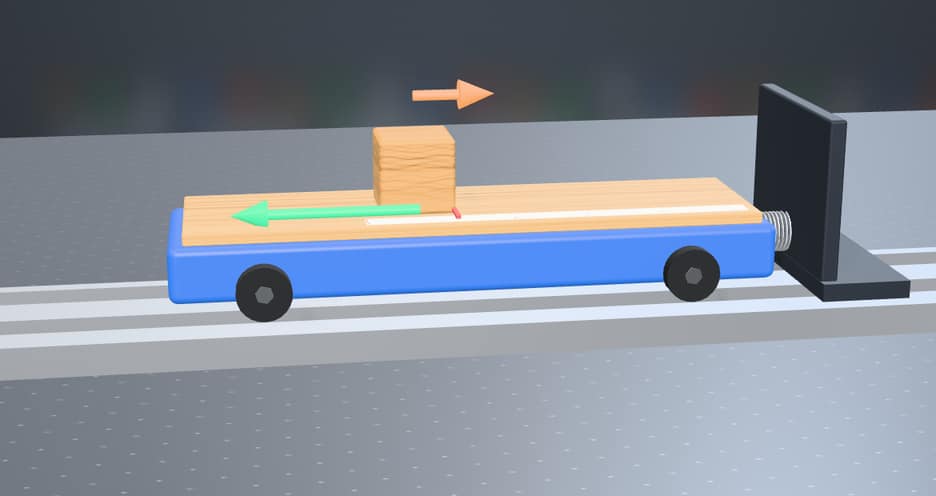
Before the impact, cart and block move together at the same speed. The buffer spring halts the cart within 0.1 s, but it only touches the cart.
Nothing connects the block to the stop. The only horizontal force on it is friction from the cart’s surface, and that is too weak to stop it within 0.1 s. So the block keeps most of its speed and slides forward along the cart.
The tendency of an object to keep its state of motion is called inertia. Inertia is not a force: nothing is pushing the block forward.
02 / What stops it?
Less resistance, a longer slide.
The block finally stops because friction from the surface keeps acting backwards. On a smoother surface the friction is weaker, the block slows more gently and slides further: about 1.5 cm on the towel, 3.6 cm on cloth, 6.5 cm on wood and 21.5 cm on glass.
Follow the trend: on a perfectly smooth surface with no resistance at all, the block would keep sliding at its original speed forever. This is Newton’s first law: an object stays at rest or keeps moving in a straight line at constant speed unless a force acts on it.
A heavier block feels a larger friction force, but it is also harder to change its motion. The two effects cancel, so the sliding distance stays the same.
03 / Back to everyday life
Why do we lurch forward when a bus brakes?
Braking is like the cart hitting the stop. Your feet and seat slow down with the vehicle, while your upper body, because of inertia, tends to keep its speed, so you lean forward. A seat belt gives your body a backward force so that it slows down with the vehicle.
When a bus pulls away suddenly, the opposite happens: your feet move forward with the bus while your upper body stays at rest, so you tip backwards.
04 / Think it through
Can you explain these?
When the cart stops, is there a forward force pushing the block?
No. The block feels only its weight, the support from the surface and backward friction. It keeps going because inertia preserves its velocity, not because anything pushes it.
What if the block were clamped to the cart before the impact?
The clamp would pass a backward force to the block. Block and cart would stop together within 0.1 s, with no sliding.
The block slides furthest on glass. Does it have more inertia there?
No. Inertia depends only on mass, so the same block has the same inertia everywhere. It slides further on glass because the friction that changes its motion is weaker.
05 / Model and sources
Model and sources
This page models idealised horizontal motion in a straight line. The cart accelerates uniformly for 1.0 s to 0.70 m/s, coasts for 0.6 s, then stops within 0.10 s at a constant deceleration after hitting the stop. The block feels only friction from the surface and slows uniformly.
- Cart braking deceleration a = v₀ / Δt = 7.0 m/s²
- Block deceleration a = μg, independent of mass
- Sliding distance d = v₀² / (2μg) − v₀Δt / 2
- Condition: the block slides only if μg is less than the cart’s braking deceleration
g = 9.806 65 m/s² comes from NIST. The wood-on-wood friction coefficient follows Engineering ToolBox (about 0.25–0.5 when dry), so wood uses 0.25. The towel (0.50), cloth (0.35) and glass (0.10) values are teaching assumptions for comparison only, not measurements. The speed, times and the 0.10 kg block mass are also teaching assumptions.
Not modelled: track friction, air resistance, wheel rotation, spring rebound and the block tipping over. Arrow lengths are only to scale as a guide; readings come from the model, not from sensors.
- OpenStax Physics 4.2 · Newton’s First Law of Motion: Inertia ↗ checked 2026-11-05
- NIST CODATA · Standard acceleration of gravity ↗ checked 2026-11-05
- Engineering ToolBox · Friction and Friction Coefficients ↗ checked 2026-11-05